
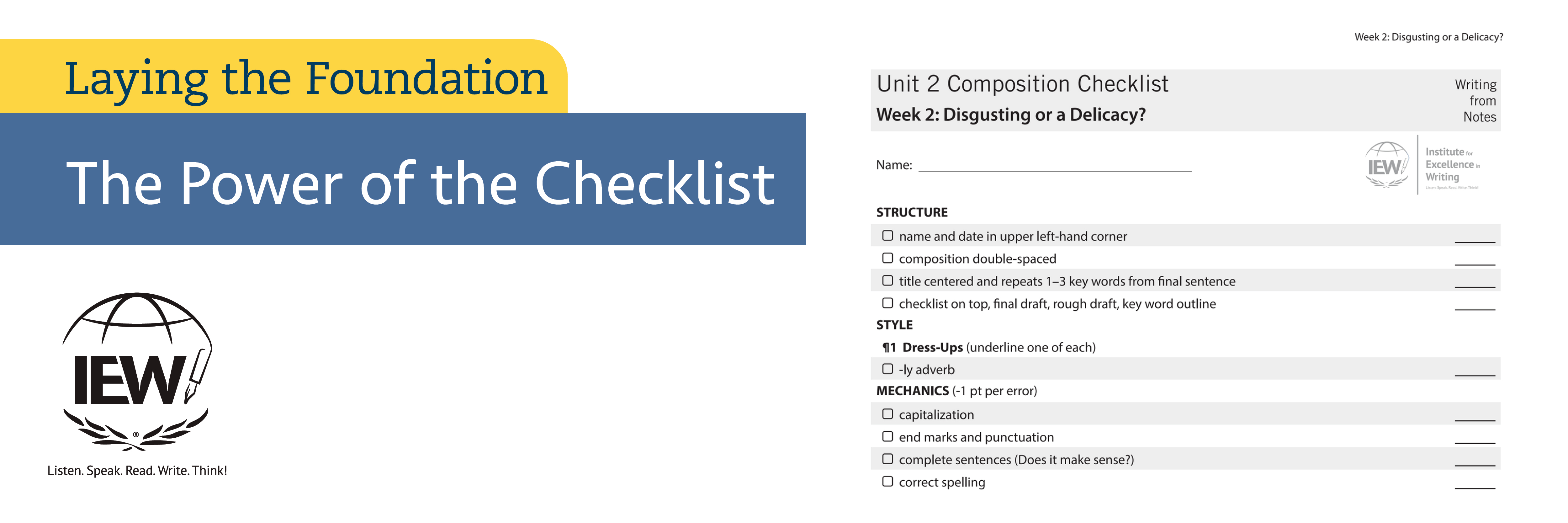
Many would agree that checklists are helpful tools. Few if any passengers would want to board a plane where the pilot just trusted without first checking that the plane was truly flightworthy. A plane’s preflight checklist is of vital importance and provides assurance that every element on the list has been considered and checked for safety. Imagine for one moment an aircraft midway through its flight whose crew discovers it doesn’t have enough fuel to reach its destination. At the very least it would cause quite a disruption in everyone’s schedule!
People use checklists for many reasons. Whether someone is shopping for groceries, running errands, or even flying a plane, a checklist provides assurance that every task is ticked off. This is equally true for IEW writing assignments. With the exception of the Unit 1: Note Making and Outlines, all of IEW’s remaining units implement a checklist. How does IEW’s checklist help students and teachers?
“Do what you check and check what you do.” – Andrew Pudewa
By its very nature, a checklist clarifies tasks. A task is either complete (checked off) or incomplete (not checked off). Using the checklist makes the task of writing much clearer for the student because the teacher’s expectations are explicitly stated. IEW’s checklists provide a way for students to verify they have met the objectives of the assignment. On the left side of the checklist page are a set of boxes the student checks off as each element of the assignment is completed.
The checklist addresses all facets of the assignment, including the structure of the assignment, the stylistic techniques to be incorporated in each paragraph of the assignment, banned words to avoid, and grammatical reminders. Once the paper is written, students are able to review the checklist another time to verify each element has been completed. Students who faithfully follow the checklist feel confident that they have met the assignment’s objectives. They know when they are done because the guesswork about what the teacher wants has been removed.
The checklist is equally beneficial for the editor as well as the teacher. After the student completes the assignment, he shares it with his editor, who can use the checklist as a tool to verify that the student has indeed completed the assignment. From there the assignment moves to the teacher.
The checklist is a powerful tool for teachers to assess their students. It provides a clear framework for grading, removing the subjectiveness of grades for a writing assignment. Using the right side of the checklist, the teacher assesses whether the student met the objectives of the assignment.
Andrew Pudewa recommends using a checklist that does not have points assigned. This type is included in the printed student packet for the Structure and Style® for Students courses. Instructors may use the checklist as an assessment tool to evaluate whether the objectives of the assignment were fully met. If they are, the student receives an “A” for accepted. If not, the student receives an “I” for incomplete. He then returns to his assignment to address the incomplete elements until he achieves the “A.”
For teachers who need points to establish percentages or grades, checklists with points are also included. Writing Across the Curriculum courses include points on all the checklists. In addition, checklists with points are available to download for the Structure and Style for Students courses. Teachers tally the points to assign a grade. Regardless of which checklist is selected, teachers no longer have the burden of subjectively deciding which assignments receive higher marks versus those that receive lower marks. The checklist drives the grading process.
Some students benefit from customized checklists. For students who need more time practicing a stylistic technique, it is easy to adjust the style elements on the checklist to match the student’s present writing ability. This reflects IEW’s philosophy of teaching EZ+1, an approach where the student is only dealing with one challenging style element at a time. Teachers can adjust the checklist by scratching off the newest item on the list, or they can easily generate custom checklists using the online IEW Checklist Generator™ if they have a Premium Membership.
Another useful tool that incorporates checklists and shortens grading time is the IEW® Gradebook. This online, subscription-based assessment tool helps by identifying checklist items, making it easier and quicker for the teacher to evaluate items and grade assignments. IEW Gradebook utilizes checklists exclusively from the Structure and Style for Students courses and most of the Writing Across the Curriculum courses. Whether you are a homeschooling parent or a teacher in a classroom, IEW Gradebook is a fabulous grading assistant.
Teaching writing is hard. The IEW Checklist helps the teacher and the student. It is just one of the elements that contributes to building a strong writing foundation.
by Jennifer Mauser